Agency? What Agency? How British Models Are Building Careers on Their Own Terms
Not long ago, the path into professional modelling in the UK had a very clear shape. You got scouted, or you applied, or someone's cousin knew someone. You signed with an agency. The agency sent you to castings. You waited. If the agency liked you enough, and the clients liked you enough, and the timing was right, something happened. If not, you waited some more.
For a lot of aspiring models — particularly those who didn't fit the narrow physical profile that agencies have historically favoured — that waiting never ended. The door simply didn't open.
So they built their own.
The Portfolio Has Left the Building
The traditional comp card and agency-curated portfolio still exist. But they're no longer the only proof of professional viability — and for a growing number of British models, they're not even the primary one.
Instagram, TikTok, and personal websites have become legitimate professional credentials. A model with 40,000 engaged followers and a coherent visual identity on Instagram has something concrete to show a brand: an audience, an aesthetic, a track record. That's not the same as a portfolio of editorial tearsheets, but in an era where brands are increasingly buying into communities rather than just images, it's often more commercially relevant.
A plus-size model from Birmingham, who built her following over three years before landing her first paid brand partnership, described the shift bluntly: "Agencies kept telling me I wasn't quite right for their books. Meanwhile, a sportswear brand found me through Instagram and offered me a campaign. The agency model just wasn't built for people like me."
She's not alone. Across the UK — in Liverpool, Glasgow, Bristol, Nottingham — models who were told they were too tall, too short, too curvy, too old, too unconventional, are finding that the internet is a considerably less discriminatory gatekeeper than the average London agency.
What a Self-Directed Strategy Actually Looks Like
Going it alone doesn't mean posting selfies and hoping for the best. The models who are making this work are approaching it with real strategic intention.
Consistency is everything. The most successful self-directed models treat their digital presence like a professional portfolio — updated regularly, visually coherent, clearly communicating who they are and what they offer. That might mean a particular colour palette on Instagram, a specific type of content on TikTok (behind-the-scenes, styling videos, industry commentary), or a personal website that functions as a proper model card with measurements, experience, and contact details.
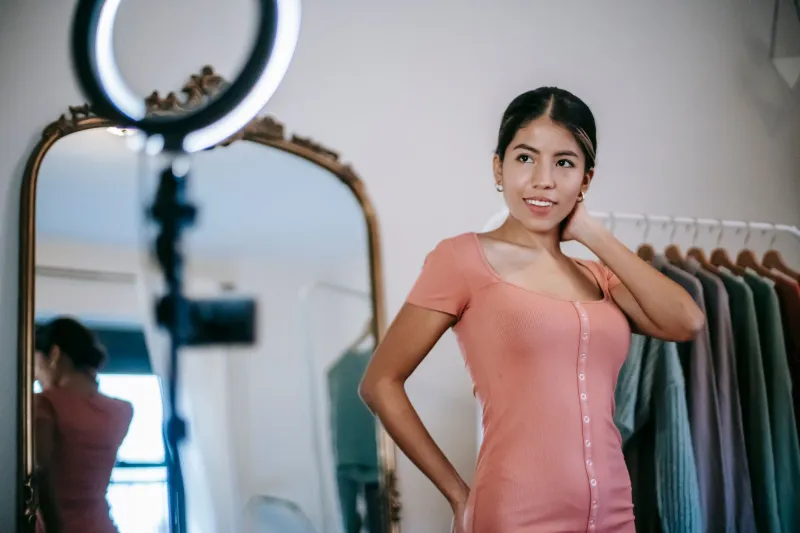
Collaboration is the other major lever. Rather than waiting for a brand to discover them, smart self-directed models are proactively reaching out to photographers for TFP (time for print, or its digital equivalent) shoots, connecting with emerging designers who need lookbook models, and building genuine relationships with other creatives in their city. The result is a portfolio that grows organically and a network that generates opportunities without requiring an agency intermediary.
TikTok deserves particular mention here. Where Instagram rewards polish, TikTok rewards personality — and that's genuinely opened doors for models who weren't traditionally 'camera ready' in the industry's narrow sense. A model from Newcastle who started posting honest content about the realities of castings and body image amassed over 80,000 followers in under a year. She's now regularly approached by brands specifically because of that authenticity. No agency involved.
The Agencies Are Paying Attention
Here's the interesting part: traditional agencies haven't ignored this shift. Many of them have started scouting through social media rather than street scouting or open calls. Some are actively approaching models with established followings and offering representation as an add-on to an already functioning career, rather than as the launchpad.
That represents a genuine power shift. A model who already has a brand audience doesn't need an agency in the same way a newcomer does — and agencies are starting to reflect that in how they approach those conversations. Signing bonuses, higher commission splits, more model-friendly contract terms: these are increasingly on the table for digitally established talent.
For models at Modelling4All, this is worth sitting with. The industry's gatekeeping was never purely about aesthetics — it was also about controlling access to clients, controlling the flow of information about rates, and maintaining a dependency relationship between models and agencies. Digital self-sufficiency disrupts all three of those dynamics simultaneously.
The Risks Are Real — Don't Skip This Bit
It would be dishonest to write about self-directed modelling careers without addressing the downsides, and there are genuine ones.
Legal protection is thinner when you're working without representation. An agency handles contract review, chases late payment, and provides a layer of professional credibility that can deter the less scrupulous end of the market. Models going solo need to be significantly more rigorous about understanding what they're signing, what usage rights they're granting, and what recourse they have if things go wrong. That's not impossible — but it requires education and vigilance that the industry doesn't automatically provide.
The algorithm is also a precarious foundation for a career. Platforms change their rules. Reach fluctuates. A single viral moment can inflate expectations that don't translate into sustainable income. Models who've built their entire brand on one platform are exposed in a way that a model with agency relationships and a diverse client base simply isn't.
And the emotional labour of managing your own career — your own marketing, your own client relationships, your own rate negotiations — is significant. It suits certain personalities and not others. There's no shame in wanting the infrastructure that an agency provides; the point is to enter that relationship with your eyes open, not because you had no alternative.
Rewriting Who Gets to Model
What the self-directed model movement ultimately represents, at its most meaningful, is a challenge to the idea that someone else gets to decide whether you belong in this industry. For every model who was told their body wasn't right, their look wasn't commercial, their postcode wasn't London enough — the ability to build a verifiable, professional track record without anyone's permission is genuinely transformative.
Modelling4All exists because we believe that every body, every story, and every background has a place on the runway. The digital revolution in modelling isn't perfect, and it isn't a complete solution to an industry still riddled with bias. But it has cracked the door open in a way that traditional gatekeeping never allowed. And for a lot of British models, that crack is all they needed.