Booked for the Brochure, Not the Campaign: The Truth About Britain's 'Silver Modelling' Boom
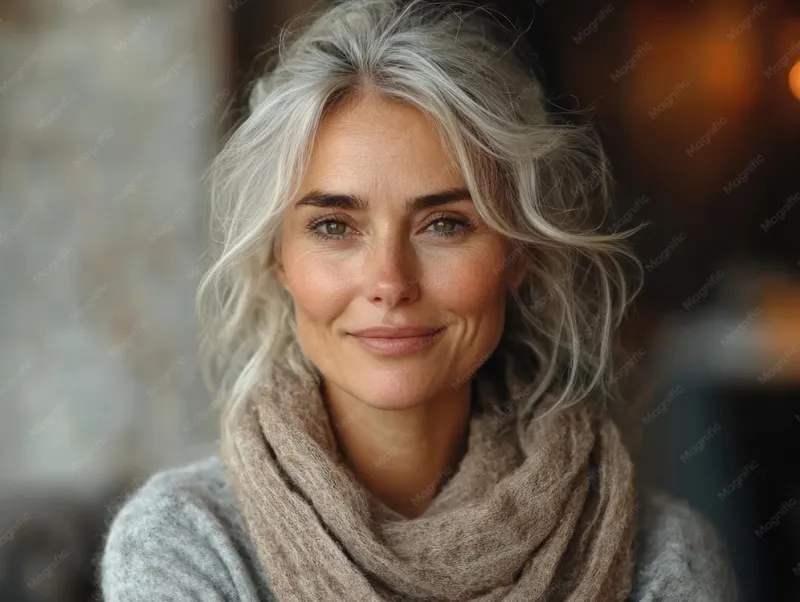
Photo: confident senior woman model grey hair studio portrait fashion, via img.freepik.com
Scroll through any lifestyle supplement and you'll see it: the beaming 60-something in a camel coat, the headline declaring that fashion has finally fallen in love with older faces. Agencies have launched 'classic' divisions. High street brands have cast grey hair in their window displays. On paper, Britain's over-50 models have never been more visible.
So why are so many of them still sitting by the phone?
The Press Release Version of Inclusivity
Talk to models in their fifties, sixties and beyond, and a pattern emerges quickly. The celebratory coverage tends to cluster around brand anniversaries, awareness days and product launches aimed squarely at older consumers. Then the campaign wraps, and the bookings dry up.
'It's the same three of us on every 'age is beautiful' shoot,' says one model in her late fifties, who asked not to be named for fear of losing work. 'We're the safe choice. The industry pats itself on the back, and nothing changes for the hundreds of us who never get in the room.'
The numbers bear this out. While mature models appear more often in editorial and PR content than they did a decade ago, agents quietly acknowledge that commercial bookings — the work that actually pays the bills — remain overwhelmingly weighted towards models under 35. Visibility, it turns out, is not the same as viability.
What Casting Directors Actually Say
Off the record, casting professionals are refreshingly honest. Several told us that the barrier isn't animosity towards older models — it's risk aversion. Brands want to be seen as inclusive without appearing to centre older people, so they cast one 'silver' face per campaign and move on. The tokenism is deliberate, even if nobody calls it that.
There's also a wardrobe problem the industry rarely admits to: many sample sizes and styling teams are simply not set up to dress a 60-year-old body with the same care they'd give a 22-year-old. Models report turning up to sets where there's no rail for them, no references, no plan — just a stylist improvising.
'If you're the only older person on a shoot, you're also the only person responsible for representing an entire generation,' one agent told us. 'That's not inclusion. That's a pressure test.'
The Models Getting On With It Anyway
Here's the hopeful part. The over-50 models thriving right now aren't waiting for the industry to fix itself. They're treating their age as a specialism, not a limitation — building portfolios that showcase grey hair, laugh lines and lived-in bodies with the same polish as any twenty-something's book.
They're also ruthlessly commercial. The successful mature models we spoke to know their market: financial services, healthcare, insurance, luxury travel — sectors with genuine budgets and genuine demand for faces that look like their customers. They track which agencies actually submit them for jobs and drop the ones that don't. They treat every 'age diversity' casting call with healthy scepticism and ask the obvious question: is this a campaign, or a press release?
What Genuine Change Would Look Like
Real age inclusivity isn't a silver-anniversary campaign. It's older models appearing in spring collections, not just funeral-planning adverts. It's multiple mature faces in a single casting, not a solitary 'diverse' booking. It's paying older models the same day rates as everyone else — something that, shockingly, still isn't guaranteed.
The UK has an ageing population and an ageing customer base. Brands that treat over-50 talent as a marketing box to tick are not just being cynical; they're being commercially thick. The models are ready. The faces are there. The only thing still waiting is the will.
Until then, Britain's over-50 models will keep doing what they've always done: turning up, doing the work brilliantly, and refusing to be a trend that goes out of fashion.